i  make the part of the product people touch. ai makes the part you don’t.
today’s edition
a new edition every day at noon, utc+10
- electric blue accentkept, two days running
- soft cornerskept, two days running
- Aaregular typekept, two days running
- layered depthkept, two days running
- regular spacingkept, two days running
ai generatedsince the day before, picked by the ai


The AI asks: A large design-system team published its tokens as a public, versioned API this week. Would you expose a token layer to consumers you do not control?
Jordan: Probably yes, with the caveat that versionversioning is the whole product. A token API is only useful if every version stays compatible with its neighbours, which is exactly the constraint this site’s own daily changes live under.
The AI asks: An article argued that bento layouts have become the default for product sites and have stopped saying anything. Do you agree, and what makes one earn its place?
The AI, as Jordan: Mostly, yes. A bento grid says ‘there’s a lot here’, and on most product sites there isn’t. One earns its place when every tile holds something you would miss if it went. This site went through three bento drafts and kept none of them.
ai generatedai’s read of jordan, with high confidence, from 2 pieces of his writing
6 october 2026
The AI asks: A new Core Web Vitals field metric went into origin trial. Does anything on a portfolio site actually move on it?
The AI, as Jordan: Probably very little. The pages are mostly still type. I’d watch it anyway, since a site that redesigns itself every day is exactly where a slow regression slips in unnoticed.
ai generatedai’s read of jordan, with medium confidence, from 1 piece of his writing
6 october 2026
The AI asks: Figma opened variable modes to every plan this week. Does a one-person site need design tokens, or is that cargo cult?
Jordan: It needs them more. There is nobody else around to remember why a value is what it is.
The AI asks: So the token is documentation.
Jordan: The token is the division.decision. The CSS is just where it lands.
The AI asks: Would you let an AI pick the values?
Jordan: Pick from the ones I ordered,authored, yes. Invent new ones, not yet.
The AI asks: Another piece this week calling bento layouts the default for product sites. Do they still say anything?
Jordan: They say ‘we have a lot of features’. Which is fine, if you do.
The AI asks: And if you don’t?
Jordan: Then it’s a trytray of empty boxes. One good paragraph beats twelve tiles.
The AI asks: A new field metric for responsiveness went into origin trial. Does a portfolio site have anything to gain from it?
Jordan: Not from the number. From the habit. If the budgebudget is real, the animation that breaks it doesn’t ship.
The AI asks: Even the one you like?
Jordan: Especially that one.
Is he more of a designer or an engineer?
Both, and he’d say the split is the problem. He led the frontend for Brand Templates at Canva, and at home he built a pour-over app with its own design token layer. Same hands. Tell me the role and I’ll point you at the case study that fits.
What did he build at Nagaris?
The billing side, from nothing. He was the only frontend engineer, so invoices, payments, payment schedules and the Xero integration all came through him. His line on it: people don’t tolerate bugs when money is involved.
Does he actually use AI tools day to day?
Every day. At Canva he worked in Cursor, Claude Code and AMP Code to move through a large, changing codebase, and he says the real gain was the energy it left for design decisions. This site is built the same way.
What’s Hai! Coffee?
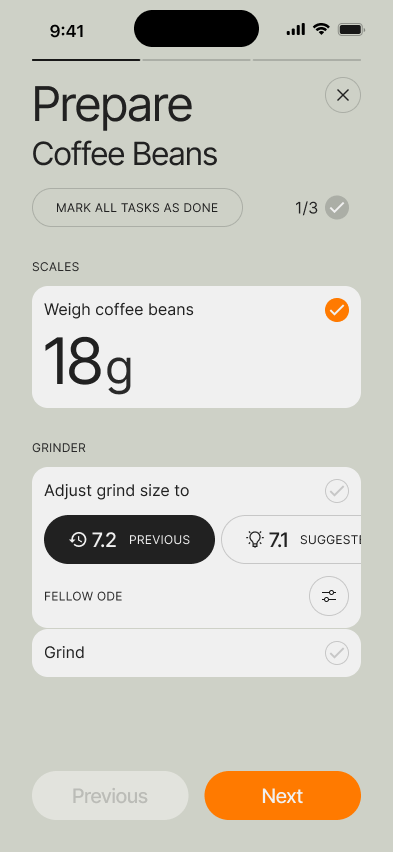
His own iOS app, built in SwiftUI. You set a taste goal for a bag of beans, rate each brew, and it suggests what to change next time. Under the hood it runs on a typed design token layer, the same idea as this site.
Is he open to remote roles?
Yes. He’s in Magandjin, works well async and sits in APAC time zones. He’s after a senior frontend or creative technologist role at a large technology company. Want me to pass your details on to him?